
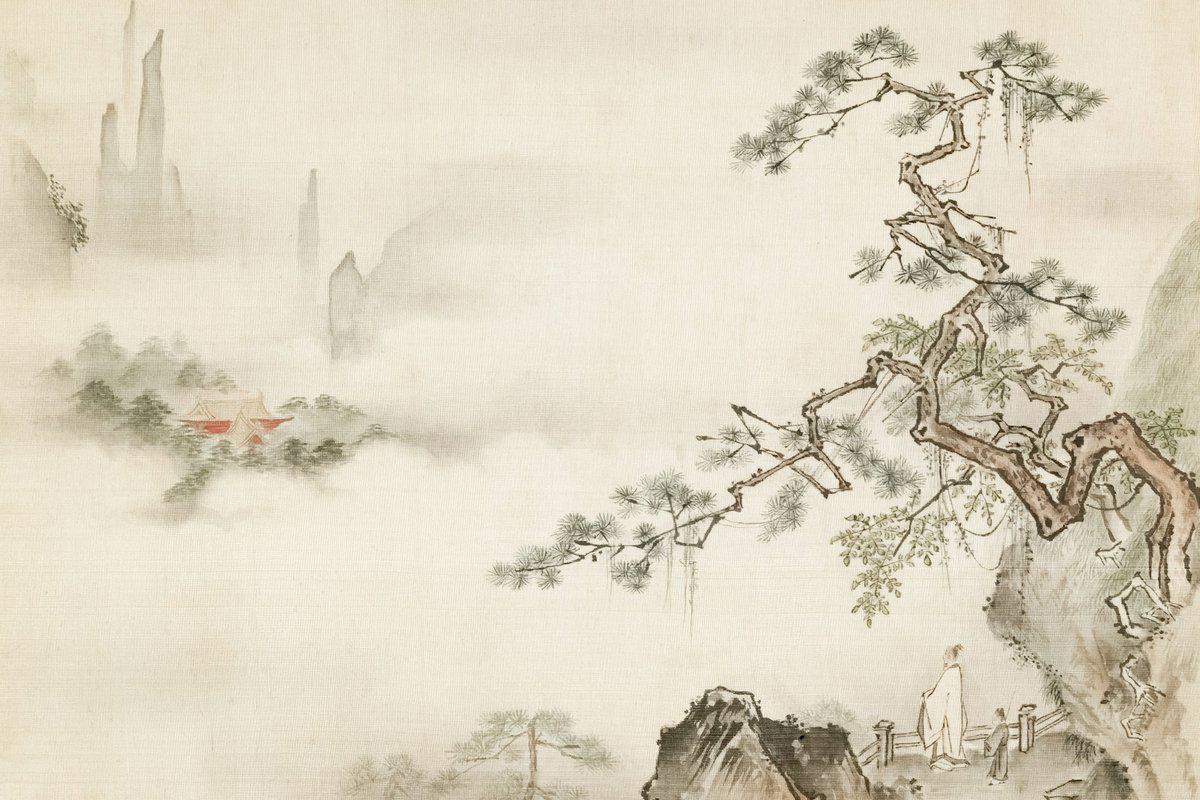
Imagine painting a mountain without actually painting it — leaving the paper blank where the peak should be, letting the viewer’s mind fill in the snow. This is Chinese ink painting (shuimo hua), an art form that values what is left unsaid as much as what is shown. In the West, painting is about adding; in China, it is often about subtracting.
The Philosophy of Emptiness #
Chinese ink painting is deeply rooted in Daoist philosophy. The empty space in a landscape — the void between mountains, the mist obscuring a valley — is not absence but presence. It is qi, the breath of the universe, flowing through the work. This principle is called liubai — leaving white. The unpainted areas are as carefully composed as the painted ones.
A single boat on an otherwise empty river suggests the vastness of the water far more powerfully than a fully rendered scene. A mountain half-hidden in mist is more real than one drawn to the last rock — because in nature, mountains are never fully visible.
The Five Colors of Ink #
A master of ink painting uses only black ink — but within that limitation lies infinite variety. The tradition speaks of mo fen wu se — ink divides into five colors: dry, wet, thick, thin, and pale. By varying water content and brush pressure, a painter can suggest every color in nature without touching a pigment.
A distant mountain is painted in pale, wet ink — almost a whisper. A foreground pine is dark, thick, and dry — a declaration. Between these extremes lies an entire vocabulary of suggestion refined over a thousand years.
Masters and Mountains #
Chinese ink painting reached its golden age during the Song Dynasty. Fan Kuan’s Travelers Among Mountains and Streams is a towering monument — a vertical scroll in which tiny human figures are dwarfed by an immense peak. The message: nature is vast, humanity is small, and the proper relationship is humble awe.
Later, the Yuan Dynasty recluse Ni Zan painted landscapes so sparse they seem to float — a single tree, a few rocks, and an ocean of empty paper. He was not painting landscapes; he was painting loneliness.