
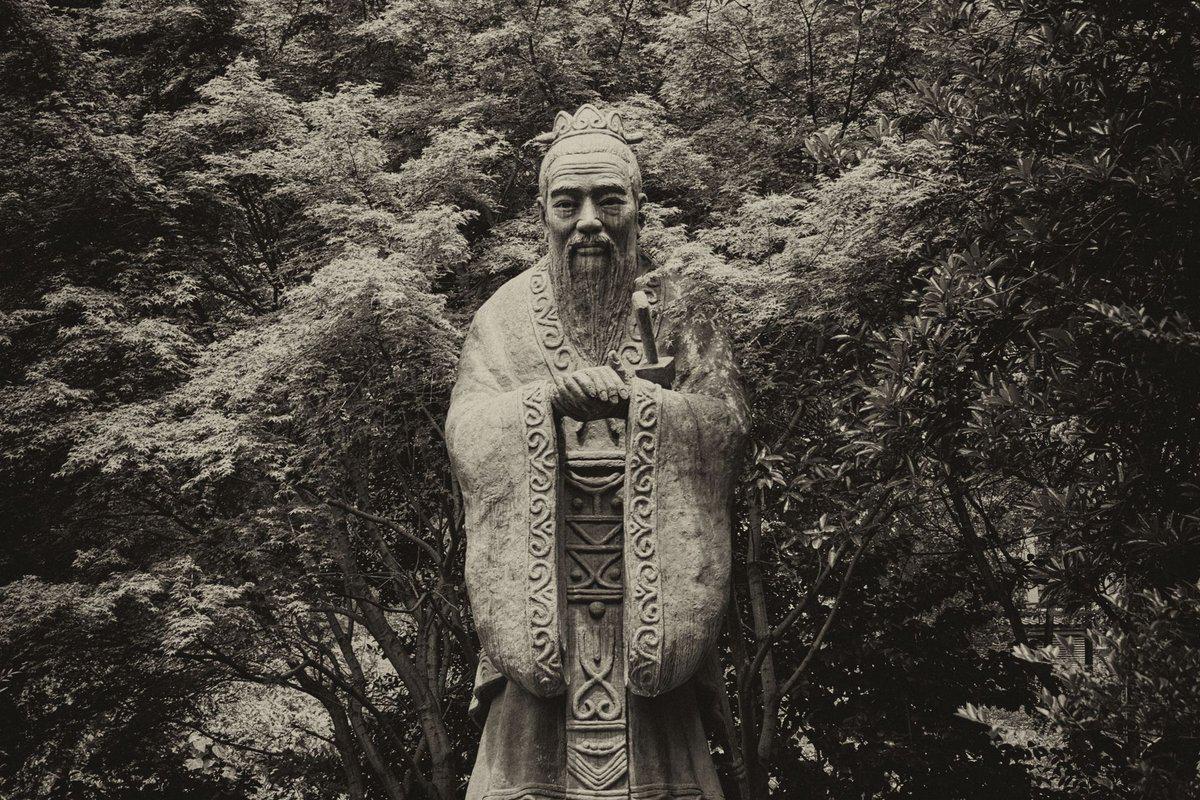
Confucius (孔子, Kongzi, 551–479 BCE) is arguably the most influential philosopher in human history. For over two and a half millennia, his teachings on ethics, governance, education, and human relationships have shaped not just China but the entire East Asian cultural sphere — from Japan and Korea to Vietnam and Singapore.
The Life of Confucius #
Confucius was born in the state of Lu (modern-day Shandong province) during the Spring and Autumn period, an era of political chaos and moral decline. The son of an elderly warrior who died when Confucius was three, he grew up in poverty but dedicated himself to learning. He studied the ancient rites, music, archery, charioteering, calligraphy, and mathematics — the “Six Arts” of the cultivated gentleman.
He held minor government posts and eventually rose to Minister of Justice in Lu, but his political career was cut short by court intrigue. For over a decade, he wandered through the warring states with a small band of disciples, offering his counsel to rulers and searching for a leader worthy of his vision. He never found one. He returned to Lu in his old age, edited the classics, and taught — dying, by his own account, unappreciated by his age. He could not have imagined what his words would become.
Core Teachings #
- Ren (仁, benevolence / humaneness) — The highest Confucian virtue. Ren is the capacity to care for others, to extend one’s concern beyond the self. Confucius defined it simply: “Do not impose on others what you yourself do not desire.”
- Li (礼, ritual propriety) — The forms and ceremonies that structure human interaction. For Confucius, li was not empty ritual but the external expression of inner reverence. Bowing, offering, speaking respectfully — these acts cultivate the virtues they express.
- Xiao (孝, filial piety) — Reverence for one’s parents and ancestors. This is the root of all virtue in Confucian thought; a person who cannot honor their parents cannot be expected to honor anyone else.
- Yi (义, righteousness) — The moral obligation to do what is right, regardless of personal cost. Unlike profit-driven action, righteous action is its own justification.
- Zhi (智, wisdom) — Not book knowledge but practical discernment — the ability to see situations clearly and act appropriately.
- Xin (信, integrity) — Keeping one’s word, being reliable, matching deed to speech.
The Analects #
The Analects (论语, Lunyu) — a collection of Confucius’s sayings and conversations compiled by his disciples after his death — is the primary source of his teachings. Its twenty short books present not a systematic philosophy but a portrait of a teacher in dialogue: sometimes witty, sometimes weary, always committed to the possibility of human improvement.
A few timeless passages:
- “To learn and then practice what one has learned — is this not a pleasure?”
- “When you see a worthy person, seek to emulate them. When you see an unworthy person, examine yourself.”
- “The noble person is slow in words but quick in deeds.”
Confucianism in the Modern World #
Confucianism was vilified during the Cultural Revolution as a feudal relic, but it has experienced a remarkable revival in 21st-century China. Confucius Institutes promote Chinese language and culture worldwide. His emphasis on education resonates in a society that invests heavily in learning. His concept of harmonious relationships finds new expression in calls for social stability and mutual respect.
More profoundly, in an age of individualism and disconnection, Confucius’s vision of humanity as fundamentally relational — our identities shaped by our roles as child, parent, friend, citizen — offers an alternative to the atomized self. As he said: “By nature, men are nearly alike; by practice, they grow wide apart.” The difference is cultivation — and cultivation, Confucius believed, is available to everyone.