
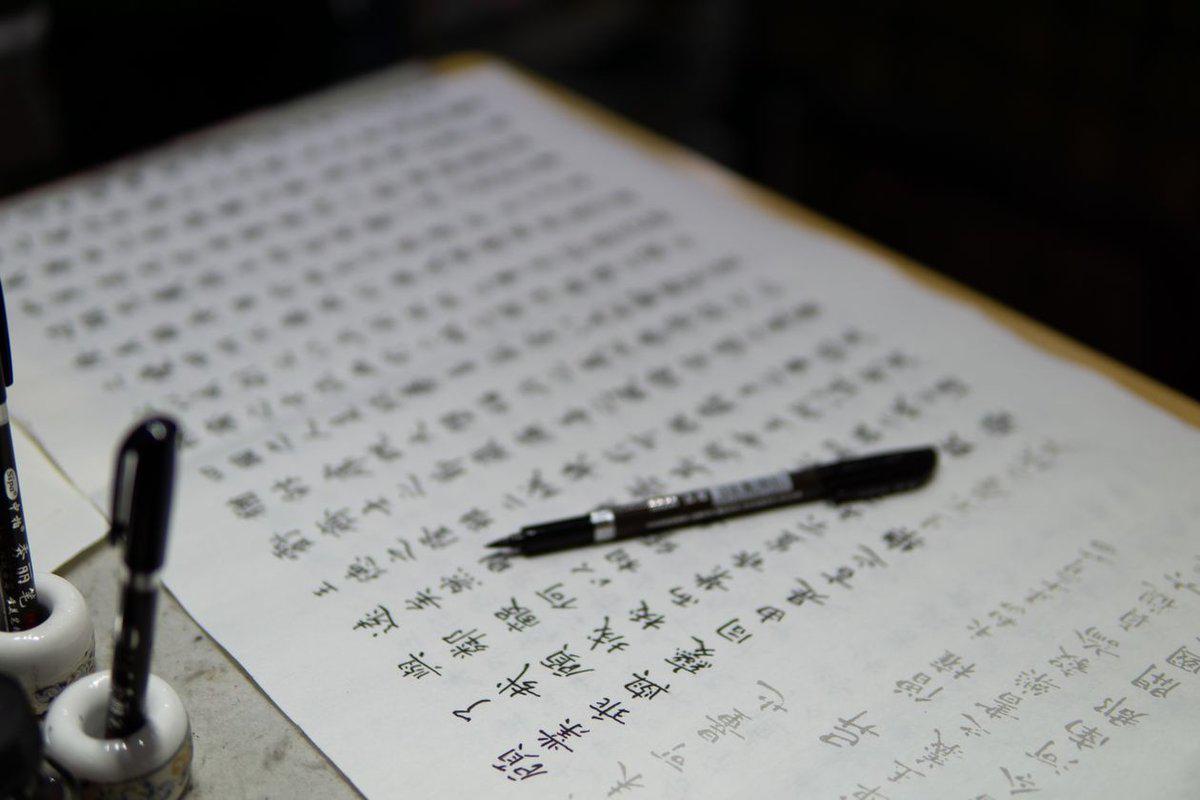
In China, handwriting is not merely a skill — it is an art form elevated to the level of poetry and painting. For over two thousand years, Chinese calligraphy (shufa) has been considered the highest of all visual arts, a practice that reveals not just the artist’s technical mastery but the very state of their soul.
The Four Treasures of the Study #
Every calligrapher’s desk holds the same four essential tools: the brush (bi), ink stick (mo), paper (zhi), and inkstone (yan). Unlike the rigid nib of a Western pen, the Chinese brush is a living thing — made of animal hair, it responds to the slightest pressure. A master can produce lines as thin as a hair or as bold as a thunderbolt from the same brush.
Xuan paper from Anhui province is so absorbent that every brushstroke is permanent. There is no erasing in calligraphy — every mark is final, a philosophy that teaches presence and commitment. The ink stick, ground fresh on the stone with water, produces ink that has outlasted empires.
The Five Major Styles #
Chinese calligraphy evolved through five principal styles, each reflecting a different era and philosophy. Seal Script (zhuanshu) is the oldest, its rounded lines carrying the weight of ancient bronze inscriptions. Clerical Script (lishu), developed by Han Dynasty clerks, introduced flat, wide strokes. Regular Script (kaishu) became the foundation of modern writing, each character perfectly balanced like a Buddhist temple.
Running Script (xingshu) flows like walking — semi-cursive, the everyday handwriting of the educated. And Cursive Script (caoshu) is the wild dance of the brush, where characters dissolve into pure abstract expression.
The Philosophy of the Brush #
Calligraphy is spiritual cultivation. The Tang Dynasty master Yan Zhenqing is revered not just for his bold, upright script, but because he died a loyal martyr — and people say they can see his integrity in every stroke. The saying zi ru qi ren — the character reveals the person — is taken literally.
To practice calligraphy is to practice patience, concentration, and presence. The brush must be held just so, the ink ground to the right consistency, the body relaxed but alert. In these simple requirements lies a complete meditation practice. The paper receives every hesitation, every moment of confidence, every flicker of doubt. In the end, the work is not just characters — it is a record of the time spent making them.